
How AI can ensure every early talent candidate receives feedback


Imagine spending hours on a job application; researching the company, crafting your cover letter, tailoring your CV and then, a week later, a generic rejection email:
"We regret to inform you we will not be progressing your application at this time."
No reason. No guidance. Sometimes within minutes of applying. Sometimes never. Nothing to reflect on and take forward.
Now imagine doing that hundreds of times.
For the majority of graduates entering the UK job market, this is not a hypothetical. It is the reality of early talent recruitment in 2026. This has resulted in candidates reducing their time to apply by using AI to support them.
For employers, receiving 140 applications per vacancy is not a number any recruiter can respond to individually. The volume of rejection messages would be a logistical impossibility for human feedback at scale. For early talent candidates, they often have to apply for hundreds of vacancies to even get a handful of interviews, where there might be a chance to get feedback if unsuccessful.
Whilst AI-enabled systems have exasperated this situation, AI could actually be part of the solution.
It's not an AI problem, it's a design problem.
Explainability is a process whereby decisions being made by AI are translated and explained to the user. Whether AI is autonomously making decisions or it is augmented with humans (human-in-the-loop), data-driven decisions can be broken down into the rules or criteria that made the decision. But it has to be built into the design.
A system built on rejection without reflection
The Institute of Student Employers has tracked the graduate recruitment market for more than thirty years. Their 2024 data revealed the challenge we face. 1.2 million applications for approximately 17,000 graduate positions. The number of applications per vacancy has tripled over the last two decades and is likely to continue to grow in the current climate.
The most competitive sectors such as digital and IT roles attracted 205 applications per vacancy, whilst financial and professional services were 188 on average. In those contexts, a recruiter giving ten minutes of considered feedback to every rejected candidate would spend more time on rejections than anything else.
And yet the expectation gap is dramatic. 93% of graduates expect to receive feedback if rejected at interview. At CV stage, the expectation is lower but the need is arguably greater. The CV screen is where most candidates are eliminated, often before a human has ever seen their application. And it is precisely here that AI-driven screening is now dominant.
"As AI makes it easier to apply for jobs, volumes are pushed up and quality down — creating more rejections. The downside is millions of rejection messages to students, with no learning attached."
Stephen Isherwood, Institute of Student Employers
It's not just good practice. It's the law.
There could be a legal exposure when using automated CV screening without explanation, if you don't have the right protections in place. UK GDPR explicitly prohibits 'computer says no' outcomes, where a decision that significantly affects someone is made solely by automated processing, with no means of understanding, inspecting or contesting it.
If a candidate's CV is screened out by an algorithm, and that candidate requests to know why, the organisation using that system has an obligation to be able to explain. Not in technical terms, but in human terms. What was missing? What would have strengthened the application?
The right to explanation under UK GDPR is not a niche concern. It applies directly to automated recruitment decisions and candidates should have the right to opt out of decisions that are solely made by automated AI. With the growing scrutiny of AI use in hiring, it is reasonable to expect this to become an area of active regulatory interest in the years ahead.
Employers can rely on the human-in-the-loop (HITL) method whereby a human is involved in the decision-making, augmented with AI. This reduces the need to offer an 'opt-out' option, however decisions should still be explainable. It is also good practice to let candidates know how and when you're using AI in recruitment to help build trust.
Recruiters need to be asking the right questions when sourcing digital solutions; understanding how AI makes decisions, if they can be overridden by a human, what limitations the system has and does the design deliver equitable opportunities.
Before and after: the difference it makes
Explainable AI designed well, means that the system scoring CVs can surface the specific criteria it assessed, which were met and which were not, and what that means for the candidate. This may include criteria that wasn't in the job description, but other criteria such as values or preferences.
The contrast with current practice is stark:
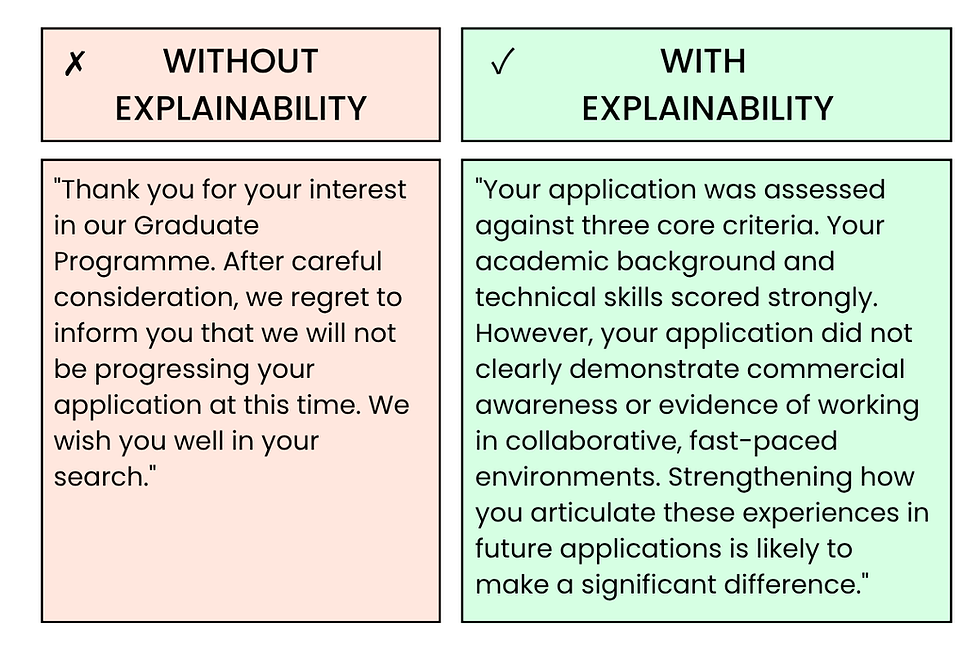
The second response takes seconds to generate. It costs nothing beyond the initial configuration of the screening system. And for the candidate, particularly someone who is new to the graduate job market or who doesn't have an inherited network to lean on, it can be genuinely transformative information.
It tells them not just that they've been unsuccessful, but why, and what to do about it to improve their chances in future.
The impact of 'word of mouth'
There is a purely commercial argument for explainability that goes beyond ethics and compliance. Rejected candidates are potentially future employees or future customers. They talk to their peers, post on Glassdoor, and form lasting impressions of organisations based on how they were treated when they didn't get the job.
72% of candidates share their negative experience with their network. However, candidates who receive respectful, useful feedback are 30–50% more likely to refer others to future roles, and 8 in 10 who have a positive rejection experience share that positivity with their network.
For a large graduate employer receiving tens of thousands of applications, the rejected majority need your focus too. They are the dominant experience of your employer brand in the market. How you treat them is not an HR operational detail, it is a strategic communications decision.
Feedback for societal good
Not all candidates have equal access to the informal feedback that helps people improve their applications. A student at a well-resourced university, from a professional family, with a careers coach and a network of industry contacts, will receive feedback through other channels such as mock interviews, mentors, alumni connections or parents who have hired people themselves.
A first-generation student applying to competitive graduate schemes with no insider knowledge of how the process works, has no such privileges. For them, employer feedback, even a structured AI-generated explanation of why their CV was screened out, may be the only substantive guidance they receive.
This is why explainable AI in graduate recruitment is not simply a nice-to-have candidate experience improvement. It is a social mobility intervention. The organisations that implement it are, in a meaningful way, levelling the playing field that has historically been tilted against less privileged candidates.
What every early talent leader should be asking
Most ATS and assessment platforms already have some form of explainability built in. What is missing is the decision to surface it to candidates rather than keeping it internal.
Does your current ATS or screening tool generate a score or ranking for each CV? If so, what criteria does it use — and can those criteria be articulated in plain English to candidates?
Are you currently using AI for any stage of CV or application screening? If yes, are you meeting your UK GDPR obligations around automated decision-making?
What does your rejection communication look like today? When did you last review it from the perspective of a less privileged student who has no other source of feedback?
Could you configure your existing screening tool to generate a candidate-facing summary of the criteria assessed, without requiring any manual recruiter input or at least minimal input?
Have you considered piloting explainable feedback at the CV stage — even for a single programme — and measuring the impact on reapplication rates, employer brand sentiment, and candidate satisfaction scores?
The AI-enabled candidate, using tools to submit multiple applications in a weekend, is already here. The AI-enabled recruiter, screening those applications in seconds, is already here. The missing piece is the AI-enabled feedback loop that closes the circle and ensures no candidate walks away from your process knowing less about themselves than when they started.
Early talent recruitment has always been about more than filling vacancies. At its best, it is about identifying potential, developing futures, and building the next generation of professionals who feel connected to the organisations that supported them on their journey.
A system on it's own is not the design. How you embed meaningful interactions into the experience, whether led by AI or human, is the design. Let's ensure it's human-centred by focusing on what early talent need.


